Chapter Eight: Accountable Access
Policies, Exceptions & Reviews: Traceable Grants
Previously
In Chapter Seven you defined access policies as functions. In Chapter Eight we step back to design. Is there a better model for organisational policy? And more generally, what are the principles behind building a schema that holds up as complexity grows?
The Situation
Amasoft’s RBAC system is working. But the CISO has a new requirement: some access grants need conditions attached — time-of-day restrictions, approval requirements, or temporary exceptions granted by named individuals with expiry dates. Most importantly, every access grant must be traceable back to the policy or exceptional reason it was granted. How should this be modelled? This is Chapter Eight’s central design debate.
The Access Policy Design Debate
We currently model access as a function. What other options do we have?
Current model: Policy as a Function
Currently access policy is encoded as a TypeQL function that we defined in Chapter Seven. The function IS the policy. It is composable and callable from any query. But the only two things you can do with it are: read its definition, or call it. It tells you who should have access right now based on current state. It cannot record why a specific grant was made, who approved it, or which policy was in effect at the time the grant was created. It answers 'should this person have access?'. It cannot answer 'under what policy was this access granted six months ago?'
New model: Policy as an Entity
Suppose we define a new entity named access_policy, and a new relation, a policy_access_grant, which links its policy as a role player.
This will allow every access grant to be backed by either a specific policy or a special audited exception. Even better, it will mandate every grant to be accountable in one of these ways.
Adopting a stricter schema means the data must comply first. Every existing grant is attached to policy only in the reader’s head, so let’s start with a clean slate:
# Check current state
match
$g isa access_grant;
# Delete all access_grant instances
match
$g isa access_grant;
delete $g;# Check new state
match
$g isa access_grant;|
💡 Deleting data in bulk
Clearing out all instances of a specific type is straightforward - get them all with When performing destructive actions such as deletion, it’s a good idea to preview your changes before committing them. Running the |
Now that the old access_grant instances are gone, let’s remodel access grants:
define
relation access_grant @abstract;
relation policy_access_grant sub access_grant,
  relates policy @card(1);
relation exception_access_grant sub access_grant,
  owns reason @card(1);

entity access_policy,
  owns name @key,
  owns description @card(1),
  plays policy_access_grant:policy;

attribute reason, value string;
policy_access_grant is now a quaternary N-ary relation - it has four role players: grantee, system, and grantor (inherited from access_grant); and policy, declared directly.
|
🏢 Entities, Relations, and Attributes
If something in the real world can exist independently (access policy, project team, department), make it an entity. If something only exists because of a connection between other things (access grant, group membership, reporting line), make it a relation. If something is just a value (permission level, date, name), make it an attribute. |
Insert the policies, then re-grant Amasoft under the new schema structure:
insert
$_ isa access_policy, has name "Engineering Access",
  has description "Engineers and their tooling";
$_ isa access_policy, has name "Manager Access",
  has description "Team HR records for managers";
$_ isa access_policy, has name "Executive Oversight",
  has description "Read access to every system for executives";
$_ isa access_policy, has name "Payments Access",
  has description "Payment systems for authorised Finance staff";
match
$alex isa full_time_employee, has email "alex.chen@amasoft.com";
$sam isa full_time_employee, has email "sam.rivera@amasoft.com";
$eng isa engineering_platform;
$p isa access_policy, has name "Engineering Access";
put
$_ isa policy_access_grant, links (grantee: $alex, system: $eng, grantor: $sam, policy: $p),
has permission_level "read",
has start_datetime 2024-01-15T09:00:00;
end;
match
$sam isa full_time_employee, has email "sam.rivera@amasoft.com";
$michelle isa full_time_employee, has email "michelle.rocksmasher@amasoft.com";
$eng isa engineering_platform;
$p isa access_policy, has name "Engineering Access";
put
$_ isa policy_access_grant, links (grantee: $sam, system: $eng, grantor: $michelle, policy: $p),
has permission_level "admin",
has start_datetime 2024-01-01T09:00:00;
end;
match
$sam isa full_time_employee, has email "sam.rivera@amasoft.com";
$michelle isa full_time_employee, has email "michelle.rocksmasher@amasoft.com";
$hr isa hr_system;
$p isa access_policy, has name "Manager Access";
put
$_ isa policy_access_grant, links (grantee: $sam, system: $hr, grantor: $michelle, policy: $p),
has permission_level "read",
has start_datetime 2024-01-01T09:00:00;
end;
match
$michelle isa full_time_employee, has email "michelle.rocksmasher@amasoft.com";
$s isa system;
$p isa access_policy, has name "Executive Oversight";
put
$_ isa policy_access_grant, links (grantee: $michelle, system: $s, grantor: $michelle, policy: $p),
has permission_level "read",
has start_datetime 2024-01-01T08:00:00;
end;
match
$grace isa full_time_employee, has email "grace.skipper@amasoft.com";
$michelle isa full_time_employee, has email "michelle.rocksmasher@amasoft.com";
$s isa payments_system;
$p isa access_policy, has name "Payments Access";
put
$_ isa policy_access_grant, links (grantee: $grace, system: $s, grantor: $michelle, policy: $p),
has permission_level "read",
has start_datetime 2024-08-01T09:00:00;
end;Remember the CI deploy bot that failed the access audit in Chapter Six? Let’s try re-inserting that access grant now. The following query should return an error:
match
$bot isa service_account, has service_name "ci-deploy-bot";
$sam isa full_time_employee, has email "sam.rivera@amasoft.com";
$eng isa engineering_platform, has name "EllipseCI";
put
$_ isa policy_access_grant, links (grantee: $bot, system: $eng, grantor: $sam),
  has permission_level "admin",
  has start_datetime 2024-01-10T09:00:00;
end;
By using the strictest possible schema, we ensure it is no longer possible to insert an access_grant without an attached policy (or exceptional reason text). It’s still possible to make mistakes - Sam could insert an exception_access_grant with a fictitious reason - but the space of possible mistakes is now drastically lowered in this new policy model.
|
💡 When to use a sub-relation
Use a sub-relation when two relation types are genuinely the same kind of thing — one is just a more specific version. An |
|
⭐ TypeDB Advantage: Polymorphism applies to relations too
In SQL, there is no concept of a relation subtype. You would need separate tables for policy_access_grants and exception_access_grants — joined by a common foreign key — and your queries would need UNION ALL to treat them uniformly. In TypeDB, querying for |
Project Teams: A Second Path to Access
Engineering’s finance integration project needs temporary payments access for its engineers — who are not Finance staff and not L5. This requires a model extension: access will be granted via project team membership rather than a permanent role.
define
entity project_team,
  owns team_name @key,
  owns project_code @card(1),
  plays project_team_membership:team,
  plays access_grant:grantee;
relation project_team_membership,
  relates team @card(1),
  relates member @card(1),
  relates added_by @card(1),
  owns start_date @card(1),
  owns end_date @card(0..1);
entity identity plays project_team_membership:member;
entity staff plays project_team_membership:added_by;
attribute team_name, value string;
attribute project_code, value string;|
⭐ TypeDB Advantage: One role, many player types
In SQL, a foreign key points at exactly one table. A grantee_id referencing the identities table cannot also reference project_teams — supporting both means an extra column or a junction table per kind of holder, and every query has to know which one to check. In TypeDB, any type the schema permits can play a role: access_grant:grantee is played by identity and project_team alike, and every existing grant query works unchanged. |
insert $_ isa project_team,
  has team_name "Finance Integration",
  has project_code "FIN-2024";
end;

# The team's grant is an exception — temporary access, with a recorded reason
match
  $t isa project_team, has team_name "Finance Integration";
  $s isa payments_system, has name "PayBuddy";
  $michelle isa full_time_employee, has email "michelle.rocksmasher@amasoft.com";
put
  $_ isa exception_access_grant, links (grantee: $t, system: $s, grantor: $michelle),
    has reason "Finance integration project — temporary PayBuddy access",
    has permission_level "read",
    has start_datetime 2024-07-15T09:00:00,
    has end_datetime 2024-12-31T17:00:00;
end;

# Alex — the team's creator — adds himself
match
  $t isa project_team, has team_name "Finance Integration";
  $alex isa full_time_employee, has email "alex.chen@amasoft.com";
put
  $_ isa project_team_membership, links (team: $t, member: $alex, added_by: $alex),
    has start_date 2024-07-15;
Now Alex has access to Amasoft’s PayBuddy account via two possible paths: his own grant, or his team’s. Query both at once with disjunction — and surface the source of access:
match
  $i has name $name;
  $s isa payments_system, has name $sys;
  { $_ isa access_grant, links (grantee: $i, system: $s);
    let $source = "direct grant"; }
  or
  { $_ isa project_team_membership, links (member: $i, team: $t);
    $_ isa access_grant, links (grantee: $t, system: $s);
    let $source = "project team"; };
fetch { "name": $name, "system": $sys, "access_via": $source };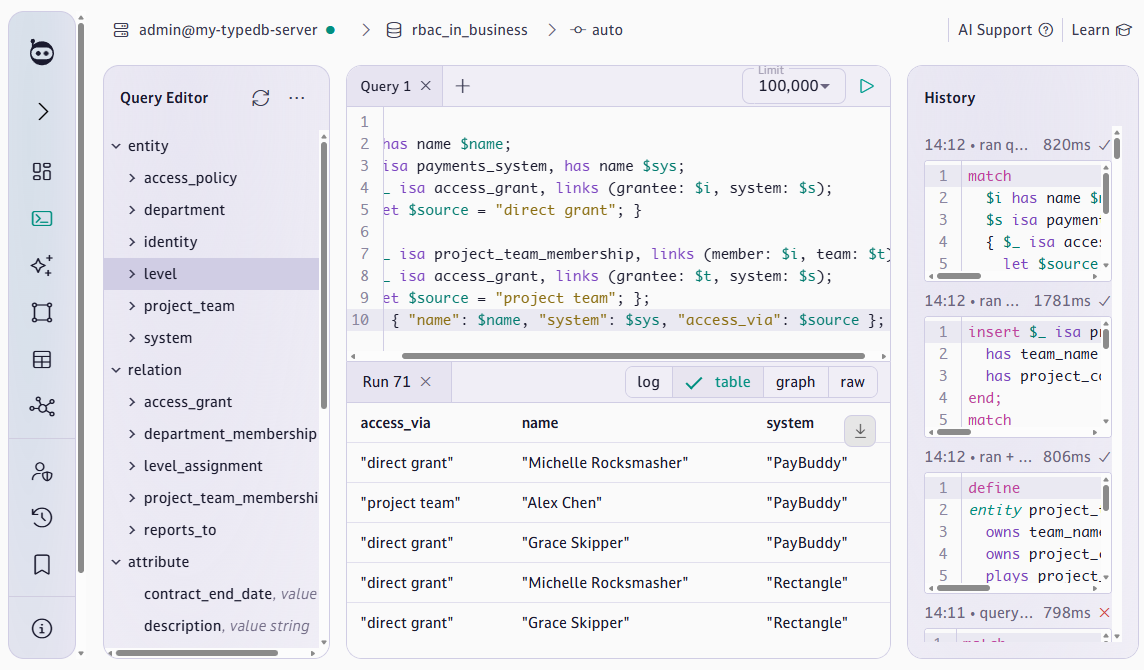
Besides the Finance team’s usual policy-based access, Alex should now appear with access to PayBuddy via project team membership. We used let here to make it clear which path each identity’s access comes through.
|
⭐ TypeDB Advantage: Disjunctive path traversal
In SQL, finding identities with access via either a direct grant or project team membership requires UNION ALL across two completely different join chains — typically five or more tables, with duplicate elimination on top. In TypeQL, both access paths are expressed as a single disjunctive pattern. TypeDB resolves both paths, deduplicates automatically, and returns the source of access in the same query. |
Reviewing the Grants
A grant is a fact; a review is a fact about that fact.
In property graphs, edges typically connect two nodes, and can’t end on other edges. Conversely, in TypeDB, relations can play roles in other relations:
define
attribute review_date, value date;
attribute outcome, value string;
relation access_review,
  relates grant @card(1),
  relates reviewer @card(1),
  owns review_date @card(1),
  owns outcome @card(1) @values("certified", "revoked");
relation access_grant plays access_review:grant;
entity permanent_staff plays access_review:reviewer;|
💡 Relations playing roles in other relations
Notice |
Chapter Eight Challenge
|
🎯 Challenge: The Policy Architecture
|