Chapter Seven: Access Policies as Functions
Enshrining Amasoft’s policies in reusable code
Previously
In Chapter Six the compliance team asked hard questions and you answered them with ad-hoc queries. Chapter Seven takes those same queries and turns them into permanent, named, reusable and composable policy logic that lives in the schema itself.
The Situation
The compliance team keeps asking the same questions. The security team wants to know who should have access to payments, not just who does. Both problems have the same solution: reusable functions.
What is a Function?
A function is a named subquery. You take a match pattern you would otherwise copy-paste, give it a name (and optionally some parameters) and define it in your schema. From then on, any query can call it, and calling it behaves exactly as if the pattern were written right there. Functions can call other functions; they can even recursively call themselves.
Let’s now define a function that determines who should have access to payments:
# name and signature: fun <function_name>(<optional parameters>) -> <return type(s)>:
define
fun who_should_have_access_to_payments() -> { staff }:
# body: a match query
  match
  $i isa staff;
  {
    $la isa level_assignment, links (assignee: $i, level: $l);
    not { $la has end_date $_; };
    $l has level_number $n; $n >= 5;
    $_ isa department_membership, links (department: $d, member: $i);
    $d isa department, has name "Finance";
  } or {
    $la isa level_assignment, links (assignee: $i, level: $l);
    not { $la has end_date $_; };
    $l has level_number $n; $n >= 7;
  };
# return statement: what this function outputs
return { $i };|
⚠️ Two syntax rules
|
We’ve successfully encapsulated Amasoft’s payment systems access policy in a single function.
Here’s the equivalent Amasoft payments access policy in SQL - the kind of query that lives in a stored procedure, or even completely outside the database, in application code:
-- SQL: the payments access policy
SELECT u.name
FROM users u
JOIN user_levels ul ON u.id = ul.user_id
AND ul.end_date IS NULL
JOIN levels l ON ul.level_id = l.id
JOIN dept_memberships dm ON u.id = dm.user_id
JOIN departments d ON dm.dept_id = d.id
AND d.name = 'Finance'
WHERE u.employment_type = 'full_time_employee'
AND l.level_number >= 5
UNION
SELECT u.name
FROM users u
JOIN user_levels ul ON u.id = ul.user_id
AND ul.end_date IS NULL
JOIN levels l ON ul.level_id = l.id
WHERE l.level_number >= 7;
This query is correct today. But when the policy changes - when someone decides L4 Finance managers should also get access - you have to find every copy of this logic and update them all. And hope you didn’t miss one.
|
🏢 The single source of truth problem
In many organisations, access policy lives in three places simultaneously: application code, a stored procedure, and a spreadsheet. They drift apart over time. Someone updates the app code and forgets the stored procedure. An auditor reads the spreadsheet and gets a different answer than the system enforces. In our TypeDB schema, the function IS the policy - a single source of truth, no drift. |
Composing functions for readability
The TypeDB function works in its current form. However, the function itself is wordy. Can we do better?
Let’s break down the function into its constituent parts, and use them to reconstruct the original function:
# Given a level ($level: integer), return a set of 'staff' at or above that level
define
fun staff_at_or_above_level($level: integer) -> { staff }:
  match
    $s isa staff;
    $la isa level_assignment, links (assignee: $s, level: $l);
    not { $la has end_date $_; };
    $l has level_number $n; $n >= $level;
  return { $s };

# Given a department name ($dept: string), return a set of 'staff' who are in that department
fun dept_members($dept: string) -> { staff }:
  match
    $_ isa department_membership, links (department: $d, member: $s);
    $d isa department, has name == $dept;
  return { $s };
Now redefine the original function using redefine:
# Redefine the original function, making it call our two other functions
redefine
fun who_should_have_access_to_payments() -> { staff }:
  match
  {
    let $s in staff_at_or_above_level(5);
    let $s in dept_members("Finance");
  } or {
    let $s in staff_at_or_above_level(7);
  };
  return { $s };
Much simpler.
|
💡 Chaining and nesting TypeDB functions
Functions compose in two ways: calling them in sequence, or calling one function inside another. When running any |
Finally, let’s call the function and retrieve the list of all staff who should have access to payment systems, as per Amasoft’s corporate policy:
match
  let $i in who_should_have_access_to_payments();
fetch { "authorised": $i.name };|
💡 The let keyword — two uses
In TypeDB 3.x,
For function calls, In general, |
|
💡 Functions as living policy documents
This TypeQL function represents the Amasoft access policy. We’ve made it easy to read as a human, easy to call in an application, and it gets updated in one place when the policy changes. |
Compliance gap - both directions
The security team needs two reports: who should have access but doesn’t (under-provisioned), and who has access but shouldn’t (over-provisioned). Both start from the same policy function.
define
# Under-provisioned - should have a grant to a payment system, but does not:
fun missing_payments_access_grants() -> { identity, system }:
  match
    let $i in who_should_have_access_to_payments();
    $s isa payments_system;
    not { $_ isa access_grant, links (grantee: $i, system: $s); };
  return { $i, $s };

# Over-provisioned - has a grant, but should not:
fun excess_payments_access_grants() -> { identity, system }:
  match
    $i isa identity;
    $s isa payments_system;
    $_ isa access_grant, links (grantee: $i, system: $s);
    not { let $i in who_should_have_access_to_payments(); };
  return { $i, $s };
Call both and check the results:
# Under-provisioned
match
  let $i, $s in missing_payments_access_grants();
  $i has name $name;
  $s has name $sys;
fetch { "needs_grant": $name, "missing_system": $sys };
end;

# Over-provisioned
match
  let $i, $s in excess_payments_access_grants();
  $i has name $name;
  $s has name $sys;
fetch { "should_revoke_access": $name, "from_system": $sys };
end;
Both reports should come back empty - Michelle is L7 and correctly has access to all payment systems; nobody has excess permissions. The data is in a healthy state.
Let’s deliberately break each one to confirm the queries work. First, under-provisioning — Amasoft hires a Finance Analyst:
# Grace Skipper joins Finance at L5 — entitled to payments access
insert $_ isa full_time_employee,
  has name "Grace Skipper",
  has email "grace.skipper@amasoft.com",
  has status "active";
end;

match
  $grace isa full_time_employee, has email "grace.skipper@amasoft.com";
  $fin isa department, has name "Finance";
  $l5 isa level, has level_number 5;
put
  $_ isa department_membership, links (member: $grace, department: $fin);
  $_ isa level_assignment, links (assignee: $grace, level: $l5),
    has start_date 2024-08-01;
end;
# Grace appears twice — once per payment system she lacks access to
match
let $i, $s in missing_payments_access_grants();
$i has name $name;
$s has name $sys;
fetch { "needs_grant": $name, "missing_system": $sys };Grace Skipper should have access to all payment systems, but in fact has access to none of them. Let’s fix that:
# Provision Grace's access to PayBuddy and Rectangle
match
  $grace isa full_time_employee, has email "grace.skipper@amasoft.com";
  $michelle isa full_time_employee, has email "michelle.rocksmasher@amasoft.com";
  $pay isa payments_system, has name "PayBuddy";
put
  $_ isa access_grant, links (grantee: $grace, system: $pay, grantor: $michelle),
    has permission_level "read",
    has start_datetime 2024-08-01T09:00:00;
end;
match
  $grace isa full_time_employee, has email "grace.skipper@amasoft.com";
  $michelle isa full_time_employee, has email "michelle.rocksmasher@amasoft.com";
  $rect isa payments_system, has name "Rectangle";
put
  $_ isa access_grant, links (grantee: $grace, system: $rect, grantor: $michelle),
    has permission_level "read",
    has start_datetime 2024-08-01T09:00:00;
end;
Now the over-provisioned direction:
# Grant Alex payments access — he's L2 in Engineering, not authorised
# (granted by Sam, who likes to move fast and break things)
match
  $alex isa full_time_employee, has email "alex.chen@amasoft.com";
  $sam isa full_time_employee, has email "sam.rivera@amasoft.com";
  $pay isa payments_system, has name "PayBuddy";
put
  $_ isa access_grant, links (grantee: $alex, system: $pay, grantor: $sam),
    has permission_level "read",
    has start_datetime 2024-08-01T09:00:00;
match
let $i, $s in excess_payments_access_grants();
fetch { "should_revoke_access": $i.name, "from_system": $s.name };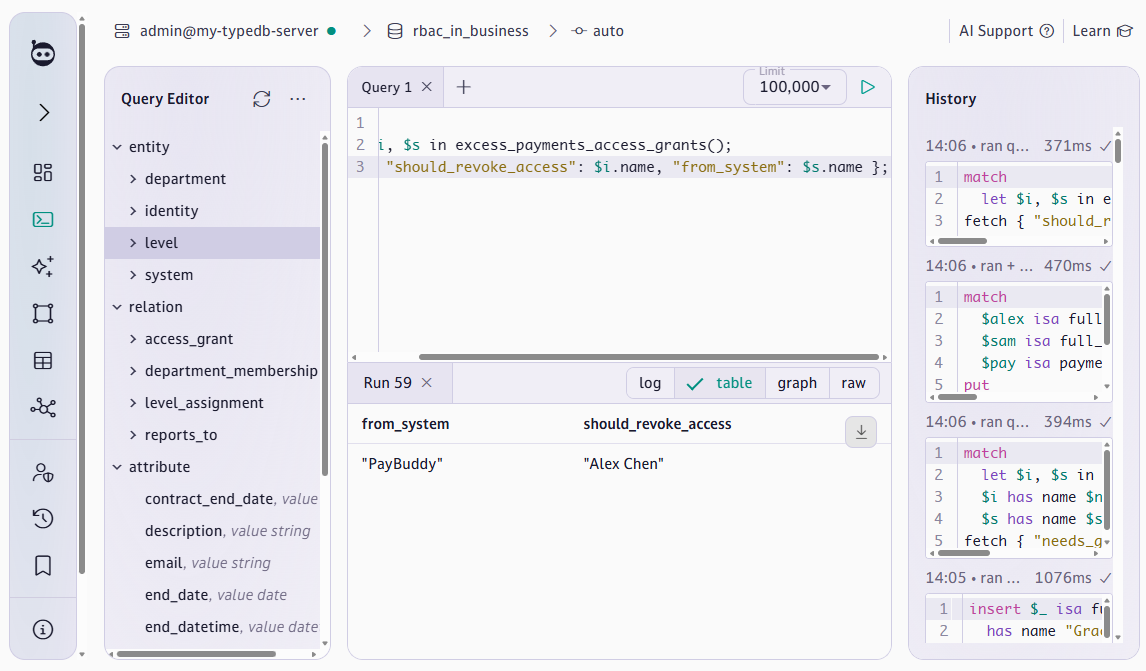
As we’ve now demonstrated, two very simple queries are sufficient to ensure actual access grants match the expectation based on company policy.
|
🏢 This is exactly what compliance teams worry about
Access drift — someone gets access they shouldn’t have, often through a one-off exception or a copy-paste error — is one of the most common RBAC failures. Most organisations discover it during an audit, months later. With TypeDB, one query finds it instantly. The policy is defined once. The gap is visible on demand. |
|
🏢 Why this is unwieldy in SQL
In SQL, 'who should have access but doesn’t' is typically written with the full policy logic as a subquery, negated against the grants table. That’s the 20-line UNION query from earlier, wrapped in a NOT EXISTS. And 'who has access but shouldn’t' is the inverse. In TypeDB, it’s one function call each. |
|
⭐ TypeDB Advantage: Policy as reusable composable logic
In SQL, access policy logic lives in application code, stored procedures, or spreadsheets — duplicated, diverging, invisible to queries. In TypeDB, the function is defined once, callable from any query, and always the single source of truth. The compliance gap queries above are only possible because the policy is a first-class named thing that can be referenced, negated, and composed. |
Separation of Duties
Separation of Duties (SoD) is often one of the more complex compliance requirements to enforce. The rule: the person who can create a payment cannot be the same person who can approve it. In SQL, enforcing SoD requires complex joins across multiple permission tables. In TypeDB, it’s a few short statements involving relations:
define
fun sod_violation() -> { identity }:
  match
    $i isa identity, has status "active";
    $pay isa payments_system;
    $hr isa hr_system;
    $_ isa access_grant, links (grantee: $i, system: $pay),
      has permission_level "write";
    $_ isa access_grant, links (grantee: $i, system: $hr),
      has permission_level "admin";
  return { $i };
match
let $i in sod_violation();
$i has name $name;
fetch { "sod_violation": $name };|
⭐ TypeDB Advantage: Separation of Duties as a first-class query
In SQL, enforcing SoD requires joining across multiple permission tables, checking multiple conditions, and usually duplicating the logic across application code and stored procedures. In TypeDB, SoD is a short, simple query, defined once as a reusable function, always consistent. When the rule changes, you have one easily readable function to update. |
Chapter Seven Challenge
|
🎯 Challenge: The Policy Engine
|
What You Can Do Now
You can now define access policies, store them as named reusable functions, find compliance gaps in both directions, enforce Separation of Duties in just 7 lines of TypeQL, and chain functions to answer complex questions. Chapter Eight makes access accountable: every grant will carry the reason it exists.